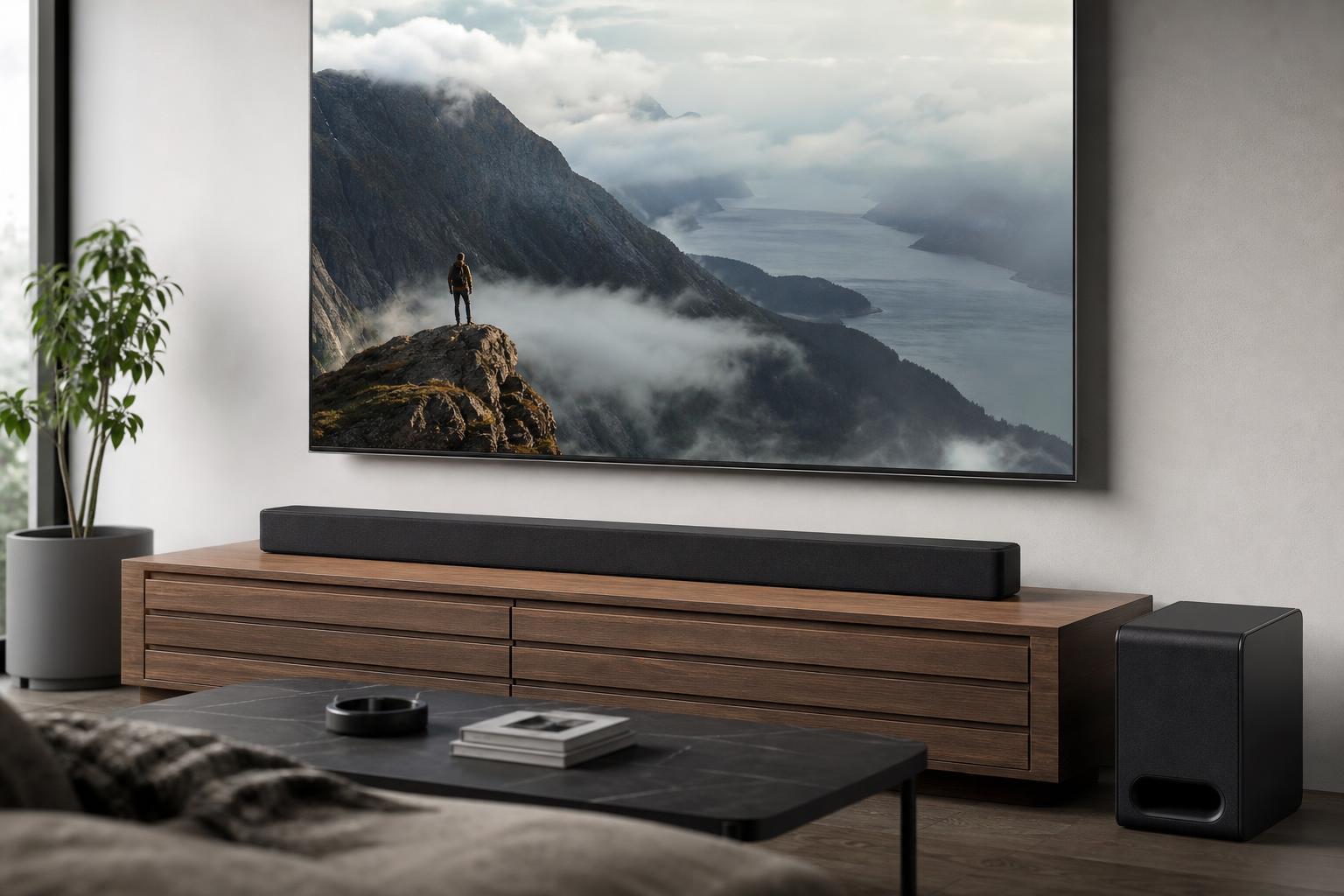
The Sony Bravia Theatre Bar 8 is a slim Dolby Atmos soundbar aimed at people who want a cleaner-looking home theater setup without giving up immersive audio. It combines a low-profile design with Sony’s upmixing and spatial audio features, making it a strong option for TVs in living rooms, bedrooms, and smaller media spaces.
This review looks at how the Theatre Bar 8 performs in everyday use, where it stands out, and where buyers may want to consider a larger or more expandable system instead.
At a Glance
- Slim soundbar with a design that fits neatly under most TVs
- Supports Dolby Atmos and DTS:X content
- Built for clear dialogue, balanced sound, and a wide front soundstage
- Works well as a premium standalone bar, with optional expansion through Sony wireless speakers and subwoofer
- Best suited to buyers who want strong sound without a bulky setup
Design and Build Quality
The Theatre Bar 8 follows Sony’s recent design language: restrained, modern, and easy to place. It has a slim body that sits low enough for most TV stands and wall-mounted setups, which reduces the chance of blocking the screen or IR receiver area.
The finish is understated rather than flashy. That works in its favor, especially for buyers who want the soundbar to disappear visually beneath the TV instead of becoming the centerpiece of the room. Buttons, ports, and controls are kept out of the way, and the overall build feels purposefully designed rather than decorative.
Sound Quality
The Theatre Bar 8’s strongest quality is its balanced sound. It is not trying to impress only with heavy bass or exaggerated effects. Instead, it focuses on producing a clear front soundstage, strong dialogue, and convincing spatial separation for movies and TV shows.
Dialogue is one of the main reasons to buy a premium soundbar, and this is an area where the Bar 8 performs well. Voices are easy to follow without sounding thin, which helps a lot with streaming shows and films where background effects and music can otherwise bury speech.
For surround effects, the bar does a respectable job of spreading sound wider than its physical size suggests. That said, like most single-bar systems, it cannot fully replace a true multi-speaker home theater. It can create a sense of height and width, but the effect is still limited by the room and the absence of rear speakers unless you add them.
Dolby Atmos and Spatial Audio Performance
Theatre Bar 8 is made for modern movie soundtracks and streaming content that uses object-based audio. With Dolby Atmos material, it aims to produce an enveloping sound field that feels more layered than a standard stereo or basic 3.1 soundbar.
The result depends on the room, the TV placement, and how reflective the surfaces are around it. In a well-sized room, the Bar 8 can project sound in a way that feels much more immersive than its compact design suggests. In a large or unusually shaped room, the illusion is still good, but it becomes less dramatic.
Music Playback
For music, the Theatre Bar 8 leans toward clean and controlled rather than overly warm or bass-heavy. That makes it easy to listen to for long periods, and it handles vocals and instruments in a tidy, organized way.
It is a good choice if you want a living-room speaker that can also do justice to playlists, streaming radio, and concert video content. However, listeners who want a more punchy, club-like sound may find it a little restrained unless they add a subwoofer.
Setup and Everyday Use
Setup is straightforward for most users. The Theatre Bar 8 is the kind of product that makes sense for someone who wants better TV sound without building a complicated system from scratch. Once connected through HDMI eARC, most of the work is done.
- Connect the soundbar to your TV’s HDMI eARC or ARC port.
- Plug the soundbar into power and switch the TV audio output to the soundbar.
- Run any built-in calibration or setup routine if available.
- Test dialogue, bass, and surround effects with a movie or show you know well.
- Adjust the sound mode or app settings if you want a different balance for movies, music, or voice-heavy content.
Ports, Features, and Connectivity
Sony equips the Theatre Bar 8 with the kind of connections most buyers will actually use rather than a crowded list of extras. HDMI eARC is the key connection for home theater use, since it lets the TV pass higher-quality audio back to the soundbar with minimal hassle.
Wireless streaming and app-based control add convenience, especially if you prefer adjusting settings from your phone instead of using the remote. The system also makes sense for Sony TV owners, since the overall experience is typically smoother when the soundbar and TV are from the same ecosystem.
- HDMI eARC for the main TV connection
- Wireless audio support for convenient streaming
- App-based control for sound adjustments and updates
- Optional expansion with matching Sony speakers and subwoofer
How It Compares to a Full Surround Setup
The Theatre Bar 8 is a strong choice if you want a premium soundbar experience without filling the room with speakers. It offers a cleaner setup than an AV receiver and separate speakers, and it is much easier to install.
That convenience comes with trade-offs. A dedicated surround system will still outperform it in speaker separation, bass impact, and rear-channel realism. If you care most about the most cinematic experience possible, a full system remains the better option. But if you want 80 to 90 percent of that feel with far less complexity, the Bar 8 makes a compelling case.
Who Should Buy It?
- People who want a premium-looking soundbar that does not dominate the TV area
- Viewers who watch a lot of streaming movies and TV shows with Dolby Atmos soundtracks
- Buyers who value clear dialogue and balanced sound over exaggerated bass
- Sony TV owners looking for a tidy, compatible home theater upgrade
- Anyone who wants a simple setup with room to expand later
Who Should Skip It?
- Buyers who want the strongest possible bass from a single device
- People who need a true rear-surround experience without adding extra speakers
- Anyone trying to build a home theater on a tight budget
- Users who prefer a warmer, more forceful sound signature over a balanced one
The Bottom Line
The Sony Bravia Theatre Bar 8 succeeds because it treats design and sound as equal priorities. It looks neat under a modern TV, sounds clear and controlled, and delivers a convincing enough sense of scale for movies and streaming content. It is not the most powerful or most expandable home theater system you can buy, but it is one of the more sensible premium soundbars for people who want great results without a complicated setup.
If you want a slim soundbar that combines good aesthetics with genuinely capable performance, the Theatre Bar 8 is easy to recommend. If you want more bass, more rear-channel impact, or a larger cinematic feel, you will probably want to pair it with additional speakers or look at a fuller surround system instead.